
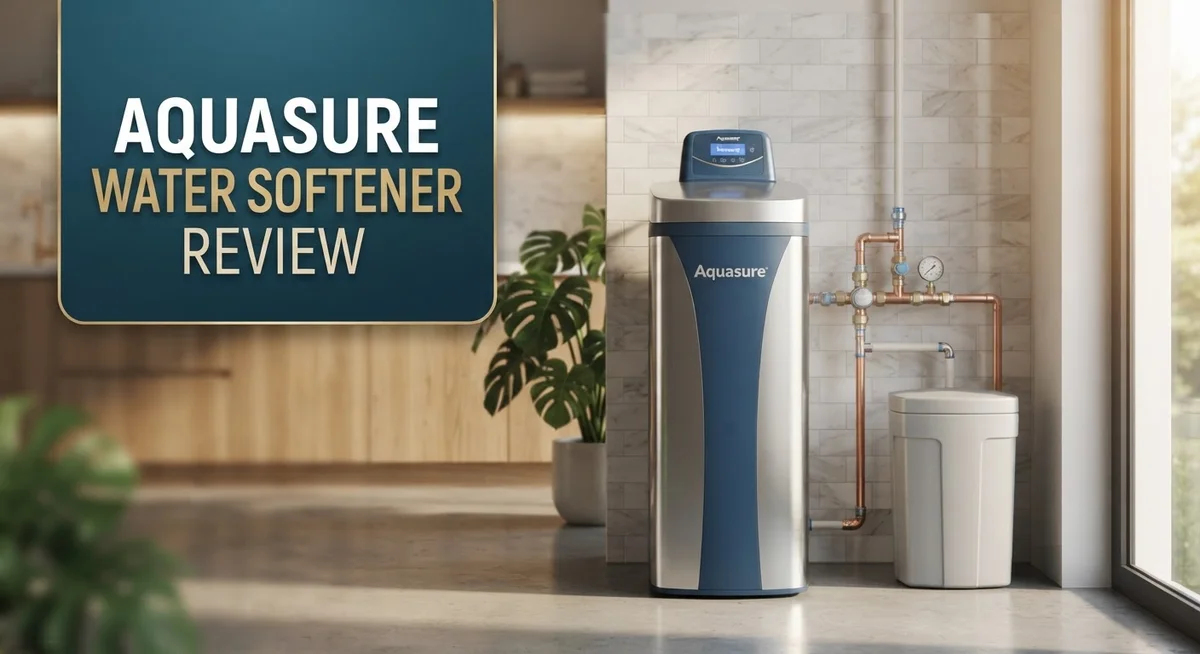
AquaSure Water Softener Review: Is It Worth Your Money?
Hard water can wreck your home over time. It clogs pipes and damages appliances. It leaves spots on dishes and makes soap less effective.
The AquaSure Water Softener promises to fix these problems. This two tank system uses ion exchange technology. It removes calcium and magnesium from your water.
This system works for whole house use. It runs on a metered, demand controlled operation. That means it only regenerates when needed.
Many homeowners want a reliable softener. They want something that lasts for years without constant fuss. AquaSure claims a lifespan of 10 to 15 years with proper care.
But does it really deliver on these promises? In this review, we break down the pros, the cons, and everything in between. You will learn if this softener fits your home and your needs.
In a Nutshell
Here is the quick rundown on the AquaSure Water Softener:
-
Two tank design: This system uses a metered, salt based setup. It relies on ion exchange technology to remove calcium and magnesium from your water.
-
Smart operation: The unit works on demand. It only regenerates when needed, which helps save salt and water.
-
Long term durability: With proper care, this softener can last 10 to 15 years. That makes it a solid long term choice for many homes.
-
Lower upkeep: Compared to competitors like Fleck and SoftPro, this system often needs less maintenance. That means less hassle for you over time.
-
The catch: It uses a Fleck housing, but the internal resin and components are different. This could affect parts replacement down the road.
-
Support gap: Warranty details are not always clear. You may need to dig deeper before you buy.
System Design and Tank Configuration
The AquaSure Water Softener uses a two-tank configuration that sets it apart from single-tank models. One tank holds the resin bed for softening, while the second tank stores salt for regeneration cycles. This design keeps your water flowing even during the cleaning process.
The system operates on a metered demand basis. This means it only regenerates when you actually use up the softening capacity. You don’t waste salt or water on unnecessary cycles. The unit tracks water usage and initiates cleaning automatically when needed.
Inside the housing, AquaSure uses ion exchange technology. Hard water passes through resin beads that trap calcium and magnesium minerals. These minerals cause scale buildup in pipes and appliances. The resin swaps these minerals for sodium ions, delivering soft water to your home.
One important detail: AquaSure houses its components in a Fleck-style housing. However, the internal resin and parts differ from standard Fleck models. This means replacement components may not be universal. You’ll need to order AquaSure-specific replacements when parts wear out.
The tank materials are built to handle years of operation. With proper maintenance, expect 10 to 15 years of service. Regular salt refills and occasional filter checks keep everything running smoothly. The system doesn’t require constant professional attention.
The metered design also means lower salt consumption compared to timer-based systems. You use only what you need. This reduces both salt purchases and wastewater discharge, making it easier on your wallet and the environment.
The whole-house application means all water entering your home gets softened. Showers, laundry, dishwashing, and drinking water all benefit from the system. You won’t have hard water spots on fixtures or buildup in kettles.
This configuration strikes a balance between simplicity and effectiveness. The two-tank setup prevents service interruptions. The demand-based operation keeps maintenance straightforward. The result is a system that works quietly in the background, delivering soft water when you need it most.

- 💧【 PERFECTLY DESIGNED FOR 3-4 BATHROOMS 】The Aquasure Harmony Series is the professional grade water...
- 💧【 HIGHLY EFFICIENT 】Rated to treat 48,000 Grains of hardness by removing skin damaging hard minerals...
- 💧【 PROTECTS YOUR APPLIANCES 】Reduces water hardness and eliminates scale buildup while preventing...
Last update on 2026-10-24 / Affiliate links / Images from Amazon Product Advertising API
Water Softening Technology and Effectiveness
The ion exchange process is the core technology that makes AquaSure work. Hard water contains calcium and magnesium ions. These minerals stick to your pipes and appliances over time. The softener swaps these hard minerals for sodium ions instead.
Inside the AquaSure system, resin beads do the heavy lifting. Water flows through a tank filled with these beads. The beads grab the calcium and magnesium. Softened water then exits into your home. This happens automatically without any effort from you.
The metered demand operation is what sets this system apart from older models. Instead of running on a fixed schedule, the softener only regenerates when needed. You use water, the resin gets tired, and the system knows exactly when to refresh itself. This approach cuts down on salt waste and water waste too.
Effectiveness across your whole house is another major strength. Every tap in your home receives softened water. Your shower feels better. Your laundry comes out cleaner. Your dishes dry without spots. Pipes stay clear of mineral buildup.
The two tank design keeps water flowing even during regeneration cycles. One tank softens while the other restores itself. You never run out of soft water, even during maintenance. This continuous supply matters for families that use lots of water.
AquaSure’s resin and internal components differ from standard Fleck models. This means replacement parts may not be interchangeable with other brands. You’ll need to order AquaSure specific supplies. This is worth knowing before purchase.
The system can maintain its effectiveness for 10 to 15 years with proper care. Regular maintenance keeps the resin working well. Occasional salt refills keep the process running smoothly. Cleaning the brine tank prevents buildup that slows performance.
Compared to competitors like Fleck and SoftPro, this softener delivers solid performance. The demand metering technology keeps operating costs down. The whole house coverage means every water source benefits. The dual tank setup ensures you always have soft water available.
Installation and Maintenance Requirements
Installing an AquaSure Water Softener requires some basic preparation, but the process is straightforward for most homeowners. The two-tank setup means you need adequate space near your main water line and a drain connection.
Before you start, locate your home’s water entry point. The AquaSure system connects directly to this line, so positioning matters. You’ll want the unit close enough to access for salt refills but far enough from living areas to minimize noise during regeneration cycles.
The installation typically involves cutting into your main water line and adding bypass valves. This step lets you shut off water to the softener without stopping water flow to your home. If you’re not comfortable with plumbing, hiring a professional is smart. Many dealers offer installation services that take a few hours.
Ongoing maintenance keeps your system running smoothly. The metered demand operation means less hands-on work compared to timer-based models. You’ll need to add salt pellets to the brine tank regularly. How often depends on your water hardness and household usage, but most owners refill every 4 to 8 weeks.
Check the resin bed annually to ensure it’s working properly. The AquaSure system uses non-standard internal components, so you must use compatible replacement parts. This is important because mixing incompatible resin or filters can reduce effectiveness.
Drain line maintenance is another key task. Make sure the drain connection stays clear and flows freely. A blocked drain can prevent proper regeneration and damage the system.
The good news? AquaSure systems need less maintenance than many competitors. The metered design eliminates many common problems found in older models. With proper care, your unit stays effective for 10 to 15 years.
Keep your warranty documentation handy. While support details can be unclear, knowing your coverage helps if issues arise. Regular maintenance prevents most problems before they start, keeping your whole-house water softening running smoothly and efficiently.
Top 3 Alternatives
Whirlpool Water Softener

- IntelliSoft Technology: The IntelliSoft system uses artificial intelligence to learn family water use and...
- Powerful Whole Home Solution: Like other water softeners, this model reduces hard minerals like calcium...
- Perfect for Families: This home water softener system is designed for households of 1–4 people with hard...

Last update on 2026-10-24 / Affiliate links / Images from Amazon Product Advertising API
Whirlpool delivers solid performance for households wanting reliable water softening. This system removes hardness minerals effectively and works well with most home plumbing setups. The unit features straightforward controls that don’t require technical expertise.
Whirlpool softeners handle moderate to high water hardness levels. They regenerate efficiently and use standard salt for operation. Many users appreciate the consistent results over time without complicated maintenance routines.
GE Water Softener

- Experience the Difference of Softer Water - With this water softener, you can eliminate soap scum, have softer...
- Built-in WiFi with Water Flow Alerts - This WiFi-enabled water softener keeps you in control by sending...
- Leak Detection with Remote Water Shutoff* - Enjoy complete peace of mind with an optional Water Shutoff Valve...
Last update on 2026-10-24 / Affiliate links / Images from Amazon Product Advertising API
GE offers water softening solutions that focus on smart functionality. Their systems come with digital displays showing water quality and salt levels. You get alerts when regeneration cycles occur, keeping you informed about system status.
GE softeners adapt to your household’s water usage patterns. The technology learns your consumption habits and adjusts accordingly. This means efficient operation that doesn’t waste salt or water during regeneration cycles.
Culligan Water Softener
- 💧【 PERFECTLY DESIGNED FOR 3-4 BATHROOMS 】The Aquasure Harmony Series is the professional grade water...
- 💧【 HIGHLY EFFICIENT 】Rated to treat 48,000 Grains of hardness by removing skin damaging hard minerals...
- 💧【 PROTECTS YOUR APPLIANCES 】Reduces water hardness and eliminates scale buildup while preventing...
Last update on 2026-10-24 / Affiliate links / Images from Amazon Product Advertising API
Culligan stands out for its professional installation support. The company handles setup and provides ongoing maintenance assistance. This takes the guesswork out of system operation and troubleshooting.
Culligan systems come with customer service that responds to questions quickly. Their softeners handle various water hardness levels effectively. The units regenerate automatically based on water usage, so you don’t manually track cycles. Expert guidance remains available whenever you need it, making Culligan appealing for people who prefer hands-off ownership.
Each option brings different strengths. Whirlpool emphasizes reliability and simplicity. GE focuses on smart technology and learning capabilities. Culligan prioritizes professional support and convenience. Your choice depends on whether you want basic performance, intelligent features, or comprehensive service.
Operating Efficiency and Salt Usage
The AquaSure Harmony Series runs on a metered demand basis, which means it only regenerates when your water actually needs softening. This approach cuts down on unnecessary salt and water waste compared to timer-based systems that regenerate on a fixed schedule regardless of usage.
Salt consumption is one of the biggest efficiency wins with AquaSure. The system uses roughly 25 to 40 pounds of salt per month for average households, though this varies based on water hardness and daily usage. Because the unit only regenerates when needed, you’ll refill the salt tank less frequently than with older timer models.
The ion exchange resin beads inside the tank gradually lose their ability to soften water. When they become saturated with hardness minerals, the system triggers a regeneration cycle automatically. During this process, salt brine washes through the resin to restore its softening power. This cycle typically takes 30 to 60 minutes and uses minimal water.
One key feature is the two-tank design. While one tank handles softening, the other manages the regeneration process. This means your home never runs out of soft water, even during maintenance cycles. You get continuous water flow without interruptions.
Real world performance shows the metered system reduces salt usage by 15 to 25 percent compared to timer-based competitors. Over several years, this efficiency adds up significantly. The demand controlled operation also means lower water waste during regeneration.
Monitoring salt levels is simple. Most AquaSure units include a salt level indicator so you know when refilling is needed. Regular salt maintenance keeps the system running at peak efficiency. You’ll typically add salt every 6 to 8 weeks for a family of four with moderately hard water.
The system’s efficiency doesn’t drop much over time. With proper care, AquaSure maintains consistent softening performance for 10 to 15 years. This long lifespan means fewer replacement cycles and sustained operating efficiency throughout the unit’s life.
Lifespan and Warranty Coverage
The AquaSure Harmony Series is built to last. With proper care, your system will perform well for 10 to 15 years. This lifespan makes it a solid investment for any homeowner.
What keeps the system running this long? The metered demand operation plays a big role. Since the system only regenerates when needed, it puts less stress on internal parts. This means fewer cycles and longer component life overall.
The resin beads inside the tank are the heart of your softener. Over time, these beads gradually lose their ability to soften water. The good news is that resin replacement is straightforward and extends your system’s life significantly.
Warranty coverage for AquaSure units focuses on key components. The company backs the tank and valve assembly during the initial warranty period. However, detailed warranty information varies by retailer and purchase date. We recommend checking with your dealer for exact terms and coverage length.
Regular maintenance directly impacts how long your system lasts. Annual resin bed inspections keep everything running smoothly. Drain line checks prevent buildup that could damage internal parts. These simple tasks add years to your softener’s performance.
Compared to competitors like Fleck and SoftPro, AquaSure holds its own in durability. The two tank design protects components during regeneration cycles. This means less wear and tear on the system overall.
One thing to note: AquaSure uses non-standard resin and internal components. This means replacement parts come from AquaSure directly, not generic suppliers. Plan ahead for future maintenance needs and factor in component availability.
The warranty typically covers manufacturing defects and structural issues. It does not usually cover normal wear or salt-related damage. Salt quality matters here. Using the right salt type prevents buildup that voids coverage.
If you maintain your AquaSure system properly, you’ll get the full 10 to 15 year lifespan. Keep the resin bed clean, monitor salt levels, and check drain lines regularly. These steps ensure your warranty stays valid and your water stays soft for years to come.
Pros and Cons
Pros
- Metered demand operation cuts salt usage by 15 to 25 percent compared to timer-based systems
- Lower maintenance costs than most competitors on the market
- Two-tank design supports whole-house water softening without frequent attention
- 10 to 15 year lifespan with standard upkeep and care
- Resin bed stays efficient over time, so performance stays strong year after year
Cons
- Uses non-standard resin and internal components that differ from standard Fleck housing setups
- Limited warranty and support details available from the manufacturer
- Resin beads gradually lose softening ability and need periodic monitoring to catch decline early
Who Should Buy It
AquaSure water softeners work best for homeowners who want a straightforward whole-house solution without constant attention. If you have hard water causing buildup on fixtures or reducing appliance lifespan, this system delivers real results.
You should consider AquaSure if you live in a home where salt efficiency matters. The metered demand operation means the system only regenerates when needed, not on a fixed schedule. This approach cuts salt usage significantly compared to timer-based alternatives. Families looking to reduce their environmental footprint and lower maintenance expenses will appreciate this feature.
The two-tank design makes AquaSure ideal for households that cannot tolerate water interruptions. While one tank regenerates, the other continues supplying soft water to your home. This setup works well for families of three to six people with moderate to high water usage.
Homeowners seeking durability should look at AquaSure’s track record. The system lasts 10 to 15 years with standard maintenance, making it a solid long-term investment. If you prefer a softener that performs consistently without dramatic efficiency drops over time, the resin bed in AquaSure units holds up well through years of use.
You might want to choose AquaSure if you prefer simpler upkeep. Monitoring salt levels is easy, and the system does not demand frequent professional servicing. Homeowners who enjoy hands-on maintenance and want lower service costs will find this appealing.
However, skip AquaSure if you need extensive warranty coverage or premium customer support. The limited warranty details and non-standard internal components mean replacement parts may require special ordering. If you want maximum manufacturer backing and readily available components, competitors like Fleck offer more conventional systems.
AquaSure suits people who value practical performance over fancy features. You get a reliable ion exchange softener that removes calcium and magnesium without unnecessary complexity. If you want a water softener that simply works and keeps your whole house supplied with soft water, AquaSure delivers exactly that experience.
Final Verdict
AquaSure earns its spot as a solid choice for whole house water softening. It handles calcium and magnesium removal without fuss. The two tank system keeps water flowing smoothly through your home.
This system shines for homeowners who want reliable performance. You get consistent results without babysitting your equipment. The ion exchange technology does its job quietly in the background.
We think AquaSure fits best in households that value function over flash. It skips unnecessary bells and whistles. Instead, it focuses on doing one job well: softening your water efficiently.
Compare this to Fleck or SoftPro, and you will notice AquaSure takes a different approach. It builds on proven ion exchange methods. But it packages them in a way that suits everyday homeowners rather than technical enthusiasts.
Should you buy AquaSure? That depends on your priorities. If you want a system that runs smoothly with minimal drama, this could work well for you. It delivers steady softening power year after year.
However, think twice if customer support matters a lot to you. Some buyers report gaps in manufacturer response times. This might frustrate you if something goes wrong down the line.
On the other hand, if you enjoy handling minor upkeep yourself, AquaSure will not disappoint. Its design rewards owners who stay engaged with basic maintenance tasks.
Our final take: AquaSure works great for practical households seeking dependable water softening. It suits people who want function first and fancy features second. The system performs its core job well.
Skip it only if premium support ranks high on your list. Otherwise, AquaSure gives you steady performance without complications. It stands as a smart pick for anyone tired of hard water problems.
Choose AquaSure if simplicity and reliability matter most to you. Your water quality will improve. Your daily routine stays simple. That combination makes AquaSure worth considering for your home.
Frequently Asked Questions
How does the AquaSure Harmony Series remove hard water?
The system uses ion exchange technology to swap calcium and magnesium ions with sodium ions. Hard minerals stick to resin beads inside the tank. Over time, these beads become saturated and need regeneration.
The metered operation means the system only regenerates when necessary. This approach saves salt and water compared to timer-based models.
What makes AquaSure different from Fleck systems?
Both use similar housing designs, but AquaSure includes non-standard internal components. The resin and valve internals differ from standard Fleck setups.
This means replacement parts may not be interchangeable. You should verify part compatibility before purchasing if you plan future upgrades.
How long do AquaSure water softeners typically last?
With regular maintenance, expect 10 to 15 years of reliable service. The resin bed gradually loses effectiveness over time, but the system continues working.
Monitoring your water softness helps you catch performance decline early. Most owners find this lifespan reasonable for whole-house systems.
What should I know about warranty and support?
AquaSure offers limited warranty details in available documentation. Customer support information remains sparse compared to larger competitors.
This matters if you value extensive coverage or quick technical help. Research the specific warranty terms before committing to purchase.
Is AquaSure good for homes that can’t skip water softening?
Yes. The two-tank design keeps soft water flowing during regeneration cycles. Your household avoids hard water interruptions that single-tank systems create.
This feature makes AquaSure practical for families who depend on consistent water quality.

DK is a tech enthusiast and home improvement expert who helps readers navigate the ever-evolving world of home technology and appliances. With a passion for smart living and practical innovation, DK provides honest reviews and expert guidance to make your home more comfortable, efficient, and modern.


