Sans Water Purifier Review: Countertop RO Filtration System
Clean water matters more than ever. Your tap water may carry hidden metals, chemicals, and tiny microplastics you cannot see.
The Sans Water Purifier claims to fix this problem. It uses reverse osmosis and UV-C purification to clean your water at home.
This countertop system filters water down to 0.0001 microns. That means it can catch arsenic, lead, cadmium, and other harmful particles.
But does it really work as promised? Some users love its compact design and filtration power. Others report leaking units and high filter replacement needs.
In this review, we break down everything you need to know. We look at real specs, genuine pros, honest cons, and how it stacks up against competitors like AquaTru.
By the end, you will know if this purifier fits your home. Let’s get into the details.
In a Nutshell
Here is the quick summary for busy readers.
- The Sans Water Purifier combines reverse osmosis with UV-C purification for double protection against contaminants.
- Its 4 layer RO filter targets heavy metals, chemicals, and microplastics in one system.
- The unit fits neatly on any countertop, making it a good pick for small kitchens.
- Some buyers reported leaking issues right out of the box, which raises quality control concerns.
- Filter replacements can add up over time, so long term upkeep matters before you decide.
- Durability data is still limited. One user noted decent performance after a year, but with some caveats.
- Compared to competitors like the AquaTru Carafe, the Sans unit holds its own on filtration power but lags in proven reliability.
In short, this purifier offers strong filtration technology in a compact frame. But potential buyers should weigh the reported leaks and filter costs against its water quality benefits.
Filtration Technology and Purification Power
The Sans Water Purifier uses reverse osmosis combined with UV-C light to clean your water at two different stages. This dual approach catches contaminants that single filter systems might miss.
The 4-layer RO filter is the heart of this system. Each layer targets specific particles and substances. The filtration goes down to 0.0001 microns, which means it stops heavy metals like arsenic, lead, and cadmium. It also removes chemicals, microplastics, and organic matter that regular tap water contains.
How does it compare to other methods? RO technology is considered the gold standard for home water purification. It works by forcing water through a membrane with tiny pores. Only clean water passes through. Everything else gets trapped and flushed away. The UV-C light then zaps any remaining bacteria or viruses that might have slipped past the filter.
The speed of filtration matters if you use water frequently. Sans delivers water at a reasonable pace for a countertop RO system. You won’t wait forever for a glass of clean water, though it’s slower than just turning on your tap.
Real users report that the system successfully removes visible cloudiness and odors from tap water. The filtered water tastes noticeably cleaner. Heavy metal removal is especially important if your area has aging pipes or industrial pollution nearby.
One important note: replacement filters need regular changes to keep the system working well. Over time, the filters get clogged with trapped contaminants. When that happens, purification power drops. You’ll need to budget for new filters as part of your maintenance routine.
Durability information remains limited at this stage. Some users report solid performance over several months, though long-term data is still being collected. Quality control appears inconsistent based on some reports of leaking units arriving from the factory.
The Sans system stands out for combining two purification methods in a compact space. This gives you more protection than basic pitcher filters or single-stage systems.

- Countertop Reverse Osmosis Water Purifier: Sans Water Purifier delivers instant crystal-clear drinking water...
- 4-Stage Reverse Osmosis Filtration: Unlike pitcher and refrigerator filters or ordinary tap water, Sans uses...
- Instant Hot Water for Coffee and Tea: Ditch the kettle and make better-tasting coffee and tea with the hot...
Last update on 2026-10-16 / Affiliate links / Images from Amazon Product Advertising API
Design, Size, and Installation
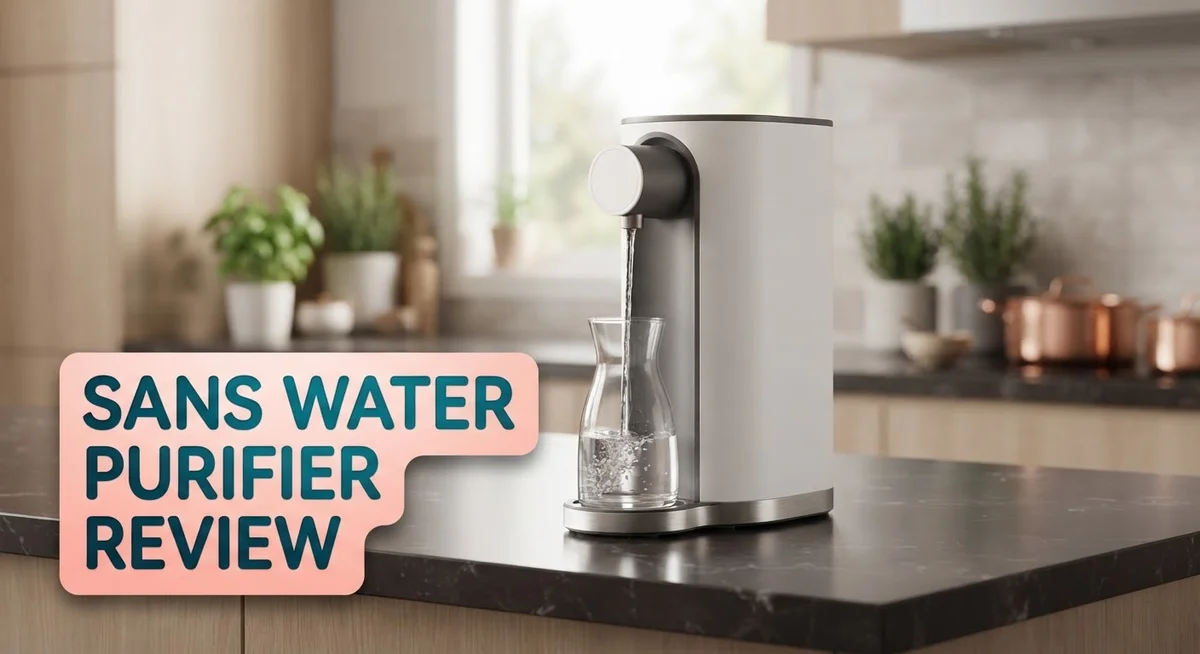
The Sans Water Purifier sits comfortably on your kitchen counter without taking up much space. Its compact footprint makes it ideal for apartments, small kitchens, or homes where cabinet space is limited.
The unit measures roughly the size of a standard coffee maker. You can place it next to your sink or on an open shelf. The aesthetic design blends well with modern kitchen decor, so it does not look like an eyesore on your counter.
Installation is straightforward and requires no special plumbing work. You simply unbox the system, fill the input tank with tap water, and it starts filtering. No drilling into walls or hiring a professional installer means you can set it up in minutes.
The system connects to your tap water supply through a simple adapter. Water flows into the input reservoir, gets filtered through the 4-layer RO membrane, and collects in the output tank below. The UV-C light chamber sits at the final stage to eliminate any remaining microorganisms.
One important consideration: the unit needs access to an electrical outlet. Make sure your countertop location has a nearby plug. The power cord is reasonably long, so positioning should not be difficult in most kitchens.
The output tank has a modest capacity, so you cannot store massive amounts of filtered water. Heavy users may need to run multiple cycles throughout the day. This design choice keeps the footprint small but requires more frequent operation.
Maintenance involves accessing the filter cartridges regularly. The system includes clear instructions for filter changes, and the compartment is easy to open. You do not need tools or technical knowledge to swap out old filters.
Space behind the unit matters too. Leave a few inches of clearance so water can drain properly if any leaks occur. Placing it on a countertop mat adds extra protection for your counter surface.
The compact design is genuinely a strength for renters and homeowners alike. You get serious filtration power without committing to permanent installation or sacrificing valuable kitchen real estate.
Water Flow Rate and Efficiency
The Sans Water Purifier delivers water at a reasonable filtration speed, making it practical for daily household use. You won’t experience long waits when filling a glass or pitcher.
The system processes water through its 4-layer RO filter, which works at 0.0001 microns. This ultra-fine filtration removes contaminants in a single pass. The combination of reverse osmosis and UV-C light means your water gets cleaned twice. First, the RO stage removes heavy metals like arsenic and lead. Then UV-C light targets any remaining microorganisms.
Real users report visible improvements in water clarity and taste. Cloudiness disappears, and odors vanish. If your tap water looks murky or smells off, this system handles those issues effectively.
However, flow rate depends on maintenance. The filters need regular changes to keep performance steady. A clogged filter slows down water output. Users should follow the replacement schedule included in the manual. Skipping maintenance will gradually reduce how fast water flows through the system.
The output tank holds a modest amount of filtered water. You cannot store huge quantities at once. This means the system works best for households that use filtered water throughout the day rather than storing it for later.
Efficiency also relates to water waste. Reverse osmosis systems typically produce some wastewater during the filtration process. The Sans unit follows this standard pattern. For every gallon of clean water, expect some water to go down the drain. This is normal for RO technology, but it’s worth knowing if water conservation matters to you.
Compared to gravity-based filters or pitcher systems, the Sans purifier moves water faster because it uses pressure to force water through the membrane. This active filtration beats passive methods by a significant margin.
For frequent water users, the reasonable speed and consistent output make this system reliable. You get clean water on demand without excessive waiting. Just remember that steady performance requires staying on top of filter replacements.
Top 3 Alternatives
LARQ Bottle PureVis

- SELF-CLEANING UV-C WATER BOTTLE - Eliminates 99% of bio-contaminants such as E. coli and mold from your water...
- NANO FILTER STRAW, 40 GALLONS PER FILTER - High-density filtration media reduces chlorine, VOCs, PFAS...
- DOUBLE-WALL VACUUM INSULATION, 24H COLD - Keeps drinks cold for up to 24 hours, so this leakproof water bottle...
Last update on 2026-10-16 / Affiliate links / Images from Amazon Product Advertising API
The LARQ Bottle PureVis uses UV-C light technology to clean your water on the go. This bottle works by activating light waves that eliminate harmful bacteria and viruses inside the bottle itself. You simply fill it, press a button, and wait a few seconds for purification to happen.
The bottle holds enough water for a full day. It’s lightweight and portable, making it perfect for travel, hiking, or commuting. The design looks modern and fits in most cup holders. Battery life lasts several weeks between charges.
LifeStraw Home Water Filter

- UNIVERSAL COMPATABILITY: Compatible with all LifeStraw Home water-purifying pitchers and dispensers for...
- COMPREHENSIVE CONTAMINANT REDUCTION: Reduces lead, mercury, and chemicals including PFAS (forever chemicals...
- ADVANCED PURIFICATION TECHNOLOGY: The only everyday water filtration system that removes bacteria and...

Last update on 2026-10-16 / Affiliate links / Images from Amazon Product Advertising API
The LifeStraw Home Water Filter sits under your kitchen sink and connects directly to your water line. It removes sediment, chlorine, and other common contaminants using a hollow-fiber membrane. You get filtered water instantly from a dedicated tap.
This system requires minimal installation and no electricity. The filter lasts for several months before replacement. It’s ideal if you want filtered water for cooking and drinking without taking up counter space. The water flow rate stays strong throughout the filter’s life.
Aqua Tru Countertop Purifier

- REMOVES WHAT ORDINARY PITCHERS LEAVE BEHIND: Go beyond basic carbon filtration to remove microplastics...
- NO PLUMBING, NO DRILLING, NO INSTALLATION: Plugs into any standard outlet and sits neatly on your counter...
- LONG-LASTING 4-STAGE FILTRATION SYSTEM: Pre/Carbon Filter lasts 6 months or 300 gallons. Reverse Osmosis...
Last update on 2026-10-16 / Affiliate links / Images from Amazon Product Advertising API
The Aqua Tru Countertop Purifier sits right on your kitchen counter and uses three-stage filtration. It combines carbon filters, a sediment filter, and a reverse osmosis membrane to remove contaminants thoroughly. Water drains into a collection pitcher that you can refill easily.
Setup takes just a few minutes. The system connects to your faucet temporarily during operation. It removes fluoride, heavy metals, and dissolved solids effectively. The pitcher holds enough purified water for several glasses. This option works well if you rent your home or prefer not to install permanent fixtures.
Filter Replacement Costs and Maintenance
Filter replacement is where you’ll notice the biggest ongoing commitment with the Sans Water Purifier. The 4-layer RO filter requires regular changes to keep your water clean and safe. Ignoring this step means your system loses its effectiveness quickly.
Most users should plan to replace filters every 6 to 12 months, depending on how much water you use and your tap water quality. Heavy usage or poor source water quality means more frequent replacements. The system will alert you when it’s time to swap out the cartridge, so you won’t forget.
Replacement filter costs add up over time. This is one area where the Sans system requires attention. You’ll need to budget for these cartridges as part of your long-term ownership. The good news is that changing filters is simple. You access the cartridges without tools and swap them in minutes. The manual provides clear instructions, and most people complete the job in under five minutes.
Beyond filter changes, maintenance is straightforward. The input and output tanks need occasional cleaning with warm water and a soft cloth. Mineral buildup can happen in hard water areas, so you may need to descale the system every few months. This process involves running a special cleaning solution through the unit, which takes about 30 minutes.
Regular maintenance keeps your system running smoothly and extends its lifespan. Check the connections monthly to catch any leaks early. Some users have reported leaking issues, so staying alert helps prevent water damage to your countertop.
The UV-C component also requires attention. While it doesn’t need replacement as often as the RO filter, you should monitor its performance. Most UV lamps last 1 to 2 years before losing effectiveness.
Think of maintenance as an investment in clean water. Staying on top of filter changes and cleaning tasks ensures your Sans purifier performs at its best. Neglecting these steps leads to poor water quality and potential system damage.
Durability and Reliability
The Sans Water Purifier uses reverse osmosis technology with UV-C purification, which are proven methods for removing contaminants. This combination gives you confidence in water quality over time.
Real users have reported positive experiences with the system’s performance. One user mentioned consistent results over a year of use, though they noted some caveats. The 4-layer RO filter working at 0.0001 microns captures heavy metals, chemicals, and microplastics effectively.
However, durability concerns exist based on user feedback. Some customers received units with leaking issues, which raised questions about quality control. This suggests you should inspect your system carefully upon arrival and test it before relying on it fully.
The compact countertop design means fewer moving parts than larger systems. Fewer components generally means fewer things can break. The unit connects to your tap through a simple adapter, reducing installation complexity that might cause damage.
Filter longevity directly impacts reliability. Most users replace filters every 6 to 12 months depending on water usage and tap water quality. Regular filter changes keep the system functioning properly and prevent performance drops. The UV-C component also requires periodic attention to maintain effectiveness.
Limited durability data exists for the Sans purifier specifically. Unlike some competitors with longer market presence, this system has fewer long-term reliability studies available. This means you’re relying partly on manufacturer claims and limited user reviews.
The system’s electrical requirement adds a dependency point. Make sure your countertop location has consistent access to power. Any electrical issues could interrupt your water supply.
Maintenance is straightforward but essential. Clear instructions guide you through filter changes. Staying on top of maintenance extends the system’s lifespan and keeps water quality consistent.
For durability assurance, check the warranty terms carefully. A strong warranty indicates manufacturer confidence in the product. Compare this with competitors like AquaTru Carafe to understand industry standards for countertop RO systems.
Overall, the Sans purifier appears reliable for daily use when maintained properly. The main durability risk involves potential manufacturing defects and the ongoing commitment to timely filter replacement.
Pros and Cons
Pros
- Removes heavy metals like arsenic and lead plus microplastics and chemicals with its 0.0001 micron filtration
- Uses reverse osmosis with UV-C technology, which are proven purification methods trusted by water treatment professionals
- Compact countertop design fits easily in most kitchens without requiring under-sink installation
- Filters water at a reasonable speed compared to gravity-based pitcher systems or basic filters
- Real users report visible improvements in water clarity and taste
Cons
- Some users received faulty units with leaking issues, indicating potential quality control problems
- Replacement filters require regular changes every 6 to 12 months and costs add up significantly over time
- Limited durability data exists for the Sans purifier, with one user reporting year-long performance that came with “caveats”
- Requires electricity to operate, creating a dependency point if power becomes unavailable
Who Should Buy It
The Sans Water Purifier works best for households that want professional-grade filtration without major installation work. You don’t need a plumber or renovation project to set it up, which makes it ideal for renters and apartment dwellers.
If you’re concerned about heavy metals in your tap water, this system targets what matters most. Arsenic, lead, and cadmium removal happens through the 4-layer RO filter. Microplastics and chemical contaminants also get trapped. This makes it suitable for families with young children or anyone with specific water quality concerns.
The countertop design appeals to people with limited kitchen space. You won’t need under-sink installation or cabinet modifications. It fits on your counter next to your coffee maker or toaster.
Real users appreciate the visible improvements in water taste and clarity. If you notice your tap water looks cloudy or tastes off, this purifier addresses those issues directly. The system works well for households that go through moderate amounts of water daily.
However, you should buy this if you’re willing to handle maintenance. Filter replacements happen every 6 to 12 months depending on your water usage. You’ll need to stay on top of these changes to keep the system running smoothly. The UV-C component also requires attention during upkeep.
Skip this purifier if you want a completely hands-off solution. Some users have reported leaking issues, so quality control varies. You should also consider this system if you want reasonable filtration speed. Gravity-based pitcher systems work slower, and the Sans delivers faster results.
The system suits people who value proven reverse osmosis and UV-C technology. These methods are trusted by water treatment professionals and remove contaminants at 0.0001 micron levels. If you want reliability backed by established purification science, this countertop option delivers.
Ultimately, the Sans Water Purifier fits households that prioritize filtration quality over minimal maintenance and want a compact, installation-free solution.
Final Verdict
The Sans Water Purifier earns its place among solid countertop RO systems. It delivers on its core promise. Clean, safe water reaches your glass with minimal fuss.
This purifier shines brightest for people who prioritize water safety. The filtration technology stands strong against contaminants that matter most. Heavy metals and microplastics do not stand a chance.
Quality control remains a valid concern. Some users faced leaking units right out of the box. This issue should not be ignored before you decide.
AquaTru Carafe still holds the top spot in many independent tests for countertop RO systems. The Sans purifier competes well but has not proven itself as thoroughly over time.
Long term durability data stays limited for this specific product. One user noted decent performance after a year but mentioned some caveats. This gap in information matters for your decision.
Who should choose this purifier? Anyone who wants strong filtration without a complicated installation process. Anyone comfortable with routine filter changes and occasional troubleshooting.
Who should look elsewhere? Anyone who wants a flawless track record with zero reported defects. Anyone who prefers a system with more established long term reviews.
The Sans Water Purifier works well for most households. It handles the essential job of removing dangerous contaminants. The compact design adds convenience many countertop buyers want.
Weigh the pros and cons carefully before you commit. The technology is sound and the results speak for themselves. Quality control issues create some hesitation, though they seem isolated rather than widespread.
If you value proven purification methods and can handle basic maintenance, this purifier deserves consideration. If you want a system with a longer track record, you might explore other options first.
Overall, the Sans Water Purifier delivers on its core promise. Clean, safer water without major installation headaches. That makes it a worthy contender in the countertop RO category.
Frequently Asked Questions
Does the Sans Water Purifier remove all types of contaminants?
The Sans system targets the most harmful substances in tap water. It eliminates heavy metals like arsenic, lead, and cadmium. The unit also removes chemicals, microplastics, and organic matter through its 4-layer RO filter and UV-C technology.
However, no purifier removes absolutely everything. The system works best against visible particles and known toxins. If you have specific water concerns, test your tap water first to see what needs filtering.
How often do I need to replace the filters?
Most users change filters every 6 to 12 months. The timing depends on your water quality and daily usage. Harder water or higher contaminant levels mean more frequent replacements.
Filter replacement is an ongoing expense you should expect. The system requires regular maintenance to keep performing well. Set a reminder on your phone so you don’t forget.
Is the Sans Water Purifier reliable for long term use?
Durability data remains limited for this specific model. One user reported solid performance over a year, though they noted some caveats. A few customers received faulty units with leaking issues, suggesting potential quality control gaps.
The reverse osmosis and UV-C technology itself is proven and trusted. The real question is how well this particular brand maintains consistency across all units. Check the warranty details before purchasing to understand what’s covered.
How does the Sans compare to other countertop RO systems?
The AquaTru Carafe currently holds the top spot in independent testing for countertop RO systems. Both use similar reverse osmosis technology and achieve excellent filtration. The Sans offers a compact aesthetic design that appeals to many kitchens.
Your choice depends on your specific needs and which system fits your space better.

DK is a tech enthusiast and home improvement expert who helps readers navigate the ever-evolving world of home technology and appliances. With a passion for smart living and practical innovation, DK provides honest reviews and expert guidance to make your home more comfortable, efficient, and modern.